Table of Contents
You notice a rough edge with your tongue, or food keeps catching around an old filling or crown, and your mind goes straight to the worst case. Is it failing? Will it need to be drilled out and redone? Will this turn into a bigger bill than you expected? That stress is common, especially when the restoration has been in place for years and seemed fine until now. In many cases, preventive dental care Newbury Park can help catch these issues early and guide the next steps.
The good news is that not every worn, uneven, or slightly imperfect restoration needs to be replaced. In some cases, a cosmetic and restorative dentist can reshape and smooth the material instead. In others, replacement is the safer choice because the restoration is leaking, cracked, decayed underneath, or no longer strong enough to do its job. The difference between recontouring a dental restoration and replacing it comes down to structure, fit, function, and what is happening at the edges you cannot see.
Dental restoration recontouring preserves what still works
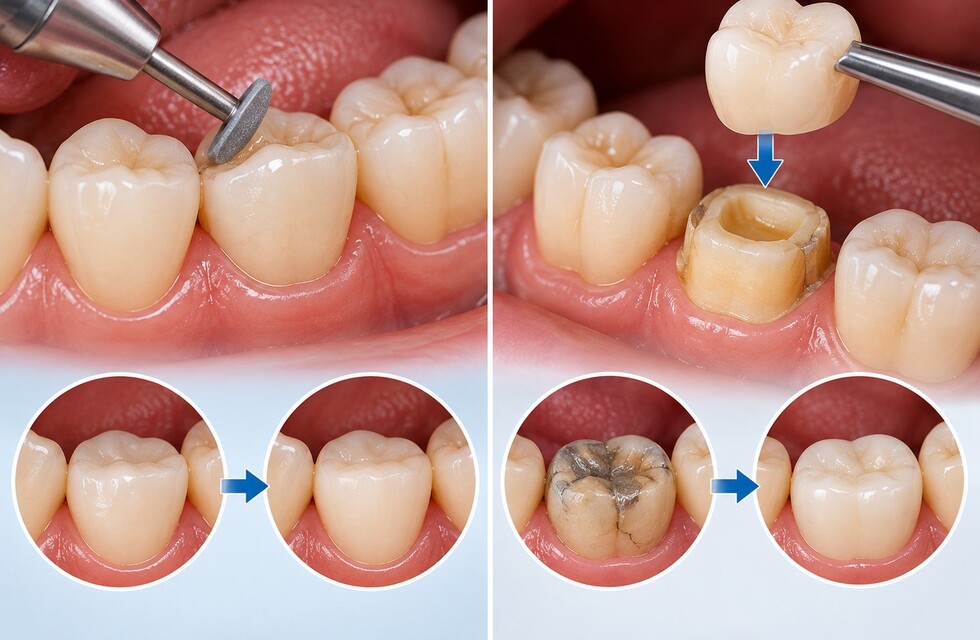
Dental restoration recontouring means adjusting the shape or surface of an existing filling, bonding, veneer, or crown without fully removing it. A dentist may polish a rough margin, reduce a high spot that changes your bite, smooth a chipped area, or refine the contour so floss passes more cleanly. This is usually the more conservative option because it keeps healthy tooth structure and avoids redoing work that may still be sound.
You may be a good candidate for recontouring if the restoration is intact, sealed well, and only needs minor refinement. A filling that feels slightly raised after you bite down, a crown with a small edge that irritates your cheek, or bonding that has lost its smooth finish can often be corrected this way. The goal is not cosmetic perfection alone. It is comfort, function, and making the area easier to keep clean.
This matters because a small shape problem can become a daily nuisance. If your bite hits one spot too hard, that tooth can start to feel tender. If floss shreds at the margin, plaque collects there more easily. If the surface is rough, stain can build up faster. Smoothing or reshaping the restoration may solve the problem before it turns into something larger.
Replacing a restoration becomes necessary when the seal or strength is lost
Replacing a filling or crown is different. The old material is removed, the tooth is evaluated, and a new restoration is placed. This is usually recommended when the existing work is cracked, broken, leaking, poorly fitting, or has decay underneath it. If the restoration no longer protects the tooth, polishing the surface will not fix the real issue.
You can think of it this way. Recontouring changes the surface. Replacement addresses the foundation. If a filling has a visible fracture, if a crown margin is open, or if x rays show decay under the restoration, keeping it in place can let damage spread. The National Institute of Dental and Craniofacial Research explains the basics of dental fillings, including why restorations sometimes need repair or replacement over time.
Age alone does not decide this. Some restorations last many years and only need minor adjustment. Others fail sooner because of grinding, a heavy bite, new decay, or changes in the tooth itself. The right call depends on what your dentist sees clinically and on x rays, not just on how long the restoration has been there.
The signs often look small before they become expensive
This is where people get stuck. The problem may seem minor because it does not hurt much yet. A little sensitivity when you drink something cold. A dark line at the edge of an old filling. A crown that feels fine most days but traps food every night. Those details are easy to put off.
That delay can backfire. If the issue is only contour, waiting often means living with irritation longer than you need to. If the issue is leakage or decay, waiting can mean more tooth loss, deeper treatment, and less conservative options later. MedlinePlus outlines tooth restoration procedures and why the condition of the tooth underneath matters as much as the visible surface.
A skilled dentist will also consider the material itself. Modern dental materials research keeps improving strength, wear resistance, and esthetics, but every material still has limits. Composite can chip or stain. Porcelain can fracture. Metal can wear opposing teeth or show edge changes over time. Sometimes a minor adjustment extends the life of a restoration. Sometimes the material has reached the end of what it can safely do.
Recontouring and replacement serve different goals
| Factor | Recontouring a Restoration | Replacing a Restoration |
|---|---|---|
| Main purpose | Refine shape, smooth roughness, adjust bite, improve cleanability | Restore strength, seal, fit, and function when the old work has failed |
| Best for | Minor chips, rough edges, slight bite imbalance, surface stain or texture issues | Cracks, open margins, recurrent decay, major wear, broken restorations |
| Tooth structure removed | Usually very little | More removal because the old restoration must come out and the tooth must be cleaned and rebuilt if needed |
| Time and cost | Often lower and faster | Usually higher because it involves a new restoration |
| Limits | Cannot fix hidden decay or structural failure | More invasive, but addresses deeper problems |
Small decisions now protect your natural tooth later
- Pay attention to changes in feel, not just pain.
If your floss catches, your bite feels off, your tongue keeps finding a sharp edge, or the tooth is trapping food, mention that clearly. Those details help your dentist tell the difference between a contour issue and a failing restoration.
- Ask whether the problem is surface level or structural.
A simple question can make the plan easier to understand. Ask if the restoration is still sealed and sound, or if there is decay, a crack, or a poor margin underneath. That gets you to the real reason behind the recommendation.
- Act before the tooth loses more support.
If your dentist recommends smoothing, do it before the roughness creates more irritation or plaque buildup. If replacement is advised, do not wait for pain to prove the point. Many teeth stay quiet while damage grows under the surface. Early treatment usually gives you more options and better odds of keeping the tooth strong.
The difference between recontouring a dental restoration and replacing it is simple at its core. Recontouring fine tunes a restoration that still works. Replacement is for a restoration that no longer protects the tooth. If something feels off, trust that instinct and have it checked. A careful exam can tell you whether a small adjustment is enough or whether starting fresh is the safer move.